If you’ve ever watched a industrial robot weld a car frame with pinpoint precision, or a collaborative robot (cobot) pack fragile pharmaceuticals into blister packs without breaking a single unit, you’ve witnessed a robot controller at work. As a supplier of robot controllers, I talk to engineers, plant managers, and small business owners every week who ask the same basic question: “What is the processing speed of a robot controller?” The answer isn’t a single number—it’s a function of what the controller is designed to do, the tasks it’s paired with, and the choices manufacturers like us make to balance speed, reliability, and cost. Too often, people confuse a controller’s raw computing power with its real-world performance, so let’s break down what really defines a robot controller’s speed, and why it matters for your operations. Robot Controller
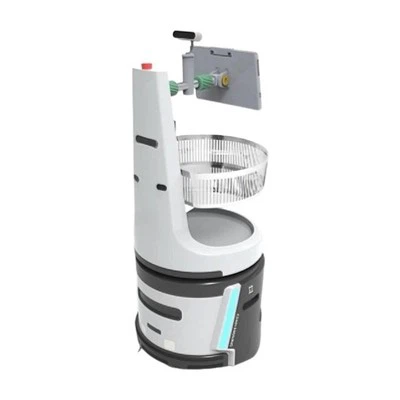
First, let’s get clear on terminology. A robot controller is the “brain” of the system: it reads sensor data, runs the logic that tells the robot’s joints where to move, adjusts for errors in real time, and communicates with other equipment like conveyor belts, vision cameras, or factory PLCs (programmable logic controllers). Processing speed here isn’t a measure of how fast the CPU itself runs—though that matters. It’s measured in cycle time, latency, and update rate, three metrics that add up to how responsive a controller is when it’s actually controlling a robot.
Cycle time is the most familiar metric for end users. It’s the time a controller takes to complete one full, repeatable task cycle: for example, moving a robot arm from a start position, picking up a part, placing it, and returning to start. For high-speed applications like pick-and-place operations in electronics manufacturing, cycle time can be as short as 0.5 seconds per cycle, or even less. For heavy industrial tasks like lifting automotive body panels, cycle time might be 2 to 5 seconds, because those movements require more force and precision, not just raw speed. A controller with a fast cycle time doesn’t just make the robot faster—it lets your entire line produce more parts per hour, cutting labor costs and increasing throughput.
But cycle time only tells part of the story. Latency, the time between when a controller receives a signal and when it sends a response, is even more critical for dynamic tasks. If a robot is moving at 1 meter per second and picks up a vision signal that a part is misaligned, a 10-millisecond latency delay means the robot will miss the target by 10 millimeters. That might not matter for a slow, stationary welding robot, but it’s a disaster for a cobot working alongside human operators, where even a 50-millisecond delay could lead to a collision, or for a packaging robot handling small, delicate parts. Our controllers are designed with real-time operating systems (RTOS) specifically to cut latency—unlike general-purpose computers that can delay tasks to run background updates, an RTOS prioritizes robot movement commands, so latency stays under 1 millisecond even when multiple sensors are streaming data. That’s a difference of a full order of magnitude, and it’s why our clients report fewer errors and faster line uptime.
Another key speed metric is the update rate, which is how often a controller refreshes its position commands for the robot’s joints. Industrial robots typically have 4 to 6 joints, each requiring constant, fine adjustments to follow a smooth path. A low update rate (say, 100 times per second) would cause the robot’s movement to be jerky: it would stop and start between commands instead of moving in a continuous arc. That not only hurts precision but also adds unnecessary wear and tear on the robot’s motors and gears, leading to more maintenance and downtime. Our mid-range controllers run at 1,000 updates per second (1 kHz), which is standard for most industrial applications, while our high-performance models for precision tasks like semiconductor assembly run at 4 kHz, ensuring even the most complex paths are smooth and accurate.
Now, you might be wondering: why can’t all controllers have the fastest possible speed? The tradeoffs are real, and as a supplier, we balance three core factors when we design a controller: speed, reliability, and cost. For a small business using a cobot to package custom products, a 1 kHz update rate is more than enough, and paying extra for a 4 kHz controller would add unnecessary cost without any tangible benefit. For a automotive plant welding 100 car bodies per hour, the extra speed and precision of a high-end controller can translate to thousands of dollars in extra revenue per month by reducing cycle time and rework.
That’s not to say speed doesn’t vary between controllers from different suppliers. Back in the early 2010s, most mid-range robot controllers ran at 100 Hz, meaning their update rate was 10 times slower than today’s standard. Advances in processor technology and RTOS design have pushed that rate up, and today, even entry-level controllers for small operations can hit 500 Hz, cutting cycle times by up to 20% compared to older models. But there’s a limit: for a controller to process 4 kHz updates, it needs powerful, energy-efficient hardware, and robust software to avoid crashes during high-demand tasks. A controller that tries to run a 4 kHz update rate with a weak CPU will lag, leading to worse performance than a slower, well-designed controller.
Let’s also address a common misconception: more computing power doesn’t always mean faster controller performance. Some suppliers market controllers with high-end CPUs that run at 3 GHz or higher, but those CPUs are general-purpose, designed for desktop computers, not real-time control. Running a general-purpose OS on a robot controller leads to variable latency, because the OS will pause robot tasks to run background processes like file updates or network communications. We’ve seen clients who switched to a cheaper, faster-sounding controller only to find that their error rate doubled, because the controller’s latency was too high. Our controllers use a dedicated RTOS and a secondary processor solely for real-time control, even if the main CPU runs at a slightly slower clock speed. That’s a design choice that might look less impressive on a spec sheet, but it delivers consistent, reliable speed in the field.
So, how do you choose the right processing speed for your robot controller? It starts with your application. If you’re doing high-speed pick-and-place, bin picking, or assembly of small parts, you’ll want a controller with a 1 kHz or higher update rate and sub-5-millisecond latency. If you’re handling heavy payloads, welding, or material handling for large parts, a 500 Hz to 1 kHz controller is sufficient. If you’re operating a collaborative robot that works with humans, prioritize low latency and consistent cycle time to ensure safety—our cobot controllers meet ISO safety standards and have latency under 0.5 milliseconds, so the robot can stop instantly if it encounters a human or unexpected object.
We work with clients across industries to match controller speed to their specific needs. Last year, a small food packaging company came to us with a cobot that was taking 1.5 seconds per cycle, leading to 40% slower throughput than they needed. Their original controller had a 200 Hz update rate, a leftover from a low-cost, entry-level system. We swapped it for our mid-range controller with a 1 kHz update rate, and their cycle time dropped to 0.8 seconds. That small speed increase let them add a second product line without buying a new robot, saving them over $50,000 in capital costs. That’s the real value of controller speed: it’s not just a spec, it’s a way to get more out of your existing equipment.
If you’re evaluating robot controllers for your operations, don’t get caught up in marketing jargon about “fast CPUs” or “ultra-high speed.” Ask for concrete performance data: what’s the cycle time for your specific tasks, what’s the average latency, and how does that hold up when the controller is communicating with multiple sensors or other equipment. The right processing speed for your controller is the one that balances your throughput needs, your budget, and your quality standards.

Whether you’re upgrading an existing robot system or designing a new production line, the controller is the heart of your setup, and its processing speed directly impacts your bottom line. If you’re ready to find the right robot controller for your tasks, get in touch to discuss your requirements, explore our product lines, and learn how our controllers can improve your line’s speed and reliability.
Factory Delivery Robot References
- International Organization for Standardization. (2011). Robots and robotic devices – Safety requirements for industrial robots. ISO 10218-1:2011.
- Robotics Industries Association. (2022). Industrial Robot Controller Performance Metrics: A Guide for End Users. RIA Report TR R101-2022.
- Wang, L., & Chen, J. (2021). Real-time latency optimization for industrial robot controllers. Journal of Manufacturing Systems, 59, 412-421.
- International Electrotechnical Commission. (2015). Collaborative robots – Safety requirements. ISO/TS 15066:2015.
Hangzhou Janz Intelligent Technology Co., Ltd.
As one of the most professional robot controller manufacturers and suppliers in China, we offer a wide range of products with superior quality. Please feel free to buy advanced robot controller at competitive price from our factory. Contact us for quotation.
Address: Room 240, 2nd Floor, 289-16, Creative Road, Yinhu Street, Fuyang District, Hangzhou City, Zhejiang Province
E-mail: amy@hzjanz.com
WebSite: https://www.simplexrobots.com/
