If you’re a stator bar user (whether you’re a plant maintenance tech, a project engineer, or someone who sources electrical components for power generation equipment), you’ve probably heard the phrase “slot discharge activity” thrown around, maybe even paired with a side eye from someone who’s had to troubleshoot a rotor stuck mid-shift. Let’s cut the jargon and break this down straight—especially since I sell stator bars for a living, so I’ve seen first-hand how this issue can turn a routine maintenance check into a three-day outage. Stator Bars
First, let’s set the scene: stator bars are the insulated electrical conductors that sit in the slots of a generator’s stator core. The slots aren’t perfectly smooth—they’re stamped with tiny grooves, burrs, or gaps from manufacturing, and over time, they can shift as the generator cycles on and off. The insulation around the stator bar isn’t just plastic wrap; it’s a multi-layered system built to withstand thousands of volts and the heat of constant operation. But if there’s any gap between the bar’s insulation and the slot wall? That’s where slot discharge activity starts.
Here’s why that gap matters: air is a lousy insulator. When a voltage difference builds up across that tiny air pocket (even a small one—like a few thousandths of an inch), it ionizes the air, creating a mini arc. That’s discharge. You might know this as corona, but when it’s inside the stator slot, away from open air, it’s specifically called slot discharge. I can’t tell you how many times a customer’s team has brushed off a small “corona spike” during a test, saying it’s no big deal—until 18 months later, that tiny arc has eaten through enough insulation to short the bar, take a turbine offline, and cost them six figures in lost power.
Let’s get specific on how it happens, because it’s not just a manufacturing flaw. New stator bars can develop gaps if the slot’s design doesn’t grip the insulation evenly. Even the best core slots have a slightly rough surface; if a bar’s insulation is too thick or too thin for the slot, there’s space left. Then, during operation, the bar vibrates—generators vibrate, especially when they’re ramping up from idle to full load. That vibration can wear down the insulation edges, creating even bigger gaps. Over time, moisture seeps into those gaps too, because insulation isn’t 100% waterproof forever. Water makes the air more conductive, so even smaller voltage differences can trigger discharge.
What does slot discharge look like in action? It’s not just a faint glow (though sometimes you can see that if you peek into a generator slot in a dark room during a low-load test). The real damage is harder to spot. Discharge is like a tiny, constant sandblaster: those ionized air particles hit the insulation at high speed, eroding the epoxy or mica layers that protect the conductor. At first, it’s microscopic—you wouldn’t see it with a regular visual inspection. After a while, the insulation gets thin enough that the conductor inside is exposed. That’s when you get a ground fault, or a phase-to-phase short, and boom—generator shutdown.
I’ve worked with hundreds of stator bar clients over the years, and the biggest mistake people make is waiting for a “big problem” to notice slot discharge. Routine testing—partial discharge (PD) testing, specifically—catches this early. Partial discharge testing sends a small voltage pulse through the stator bars and measures the tiny electrical signals from those micro arcs. If the PD readings are above a threshold (usually around 100 pC, but that varies by generator size), that’s your slot discharge knocking. But here’s the thing: not all PD is slot discharge. There’s end-winding discharge too, which happens outside the slots, and corona on the surface. But slot discharge is the most common and the most damaging, because it’s trapped inside the core where you can’t fix it easily without pulling the rotor.
Now, let’s talk about how we as a stator bar supplier help with this. A lot of people think stator bars are just “wires with insulation,” but there’s a ton of design that goes into minimizing slot discharge. For our bars, we use a variable-thickness insulation system that matches the slot’s exact surface profile—no gaps left, even after vibration. We also add a layer of semiconducting stress grading material right at the bar’s edge, where the slot’s walls meet the insulation. That material evens out the electric field, so there’s no sharp spot where voltage can build up enough to ionize the air. We test every bar for PD before it leaves our shop, so our customers don’t have to deal with surprises on-site.
I remember a client last year who had a 100 MW generator that was throwing PD alarms out of nowhere. Their in-house team replaced a set of bars and the alarms came back. Turns out, the old bars had generic insulation that was too thin for their slot, leaving a 0.015-inch gap—small, but enough for discharge to build up. We supplied a set of bars with our custom fit insulation, and their PD readings dropped from 250 pC to under 50 pC, way below the safety limit. They told us that saved them a planned outage they’d have had to schedule the next quarter, which would’ve cost them over $120k in revenue. That’s the kind of win that makes this job worth it.
Wait, let’s address a common myth: some people think slot discharge is only an issue for old generators. Nope. We’ve had new generators (less than 5 years old) with slot discharge because the core slots were stamped with burrs that weren’t cleaned properly during assembly. The builder skipped a step to save time, and now the owner is stuck replacing bars early. That’s why working with a stator bar supplier that does on-site fit checks (we do that, by the way) is key—we can measure the slot, adjust the bar’s insulation, and eliminate gaps before they cause damage.
Another thing: slot discharge doesn’t just ruin bars. It can damage the stator core too. The tiny arcs from discharge generate heat, even if it’s just a few degrees, over time that heat can break down the core’s laminated steel, leading to core losses and lower generator efficiency. I’ve seen cores that were almost unusable because slot discharge had pitted the steel edges—costing twice as much in core repairs as it would’ve cost to replace the bars proactively.
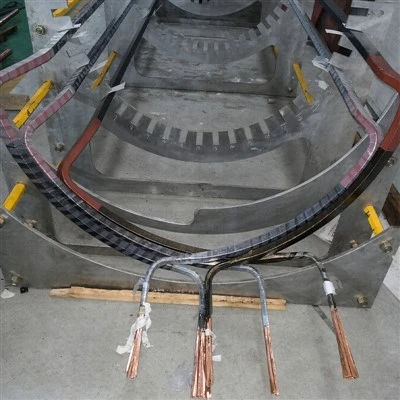
So what can you do if you suspect slot discharge activity? First, get a partial discharge test done by a certified tech. If the PD results point to slot discharge, don’t wait. There are temporary fixes (like slot fillers to block gaps), but those are band-aids. The long-term solution is to replace the affected stator bars with ones designed to minimize gap formation. If you’re planning a generator overhaul, make sure your stator bar supplier offers custom insulation fitting, PD pre-testing, and on-site support to ensure the bars seat correctly in the slots.
Stator Coils At the end of the day, slot discharge activity is one of the biggest hidden threats to generator reliability. It’s small, it starts slow, and it’s easy to ignore until it’s too late. As a stator bar supplier, our job isn’t just to sell you a bar—it’s to make sure that bar fits right, stands up to the heat and vibration, and eliminates that tiny gap that turns into a costly outage. If you’re dealing with PD readings you can’t explain, or you’re planning a generator maintenance and need new stator bars that won’t leave you with slot discharge headaches, reach out to our team. We’ve got the experience, the testing tools, and the custom solutions to get your generator running smoothly without the surprises.
References
- IEEE Std 1129™-2018, “IEEE Guide for Partial Discharge Testing of Rotating Machinery Windings,” Institute of Electrical and Electronics Engineers, 2018.
- “Stator Winding Insulation Discharge Mechanisms in Large Synchronous Generators,” EPRI Report GL-100747, Electric Power Research Institute, 2004.
- Li, Y., et al., “Slot Discharge Activity in Stator Windings: Causes, Detection, and Mitigation,” IEEE Transactions on Dielectrics and Electrical Insulation, Vol. 22, No. 3, 2015, pp. 1582–1589.
Hangzhou Purun Science & Technology Co., Ltd.
As one of the most professional stator bars manufacturers and suppliers in China, we have world-leading production equipment and strong manufacturing capabilities. Please rest assured to wholesale customized stator bars made in China here from our factory. Welcome to contact us for pricelist.
Address:
E-mail: Purun_sci_tech@163.com
WebSite: https://www.puruncoil.com/
