As a supplier of submersible pump cables, I often encounter customers who are unsure about whether a particular cable is suitable for their specific pump. Selecting the right cable is crucial as it directly impacts the performance, safety, and longevity of the submersible pump system. In this blog, I’ll share some key factors and methods to check if a submersible pump cable is suitable for a specific pump. Submersible Pump Cable
Understanding the Basics of Submersible Pump Cables
Before delving into the checking process, it’s essential to understand what submersible pump cables are and what makes them unique. Submersible pump cables are designed to operate underwater, which means they need to have excellent waterproof and insulation properties. They are typically made of materials that can withstand the harsh conditions of being submerged, such as water, chemicals, and mechanical stress.
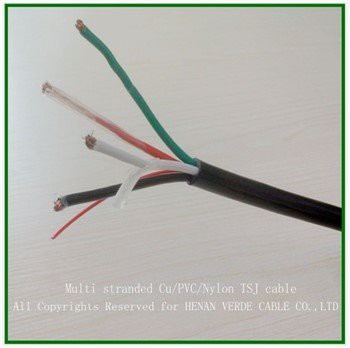
The main components of a submersible pump cable include the conductor, insulation, and outer sheath. The conductor is responsible for carrying the electrical current, and it’s usually made of copper or aluminum due to their high conductivity. The insulation material surrounds the conductor to prevent electrical leakage and ensure safety. Common insulation materials include cross – linked polyethylene (XLPE) and polyvinyl chloride (PVC). The outer sheath provides additional protection against abrasion, chemicals, and water ingress.
Factors to Consider When Checking Cable Suitability
1. Voltage Rating
The first and most important factor to consider is the voltage rating of the cable. The voltage rating of the cable must match the voltage requirements of the pump. If the cable’s voltage rating is too low, it can lead to overheating, insulation breakdown, and even electrical fires. On the other hand, using a cable with a much higher voltage rating than necessary can be unnecessarily expensive.
To check the voltage rating, refer to the pump’s user manual or technical specifications, which should clearly state the required voltage. Then, verify the voltage rating of the cable, which is usually marked on the cable itself. For example, if the pump requires a 220V supply, the cable should have a voltage rating of at least 220V.
2. Current – Carrying Capacity
The current – carrying capacity, also known as ampacity, is another critical factor. It refers to the maximum amount of electrical current that the cable can safely carry without overheating. The ampacity of the cable depends on several factors, including the size of the conductor, the type of insulation, and the ambient temperature.
To determine the required current – carrying capacity for the pump, you can use the pump’s power rating. The formula to calculate the current (I) is (I=\frac{P}{V}), where P is the power of the pump in watts and V is the voltage. For example, if a pump has a power rating of 1100W and operates at 220V, the current is (I = \frac{1100}{220}=5A).
Once you’ve calculated the required current, select a cable with an ampacity that is equal to or greater than the calculated value. Cable manufacturers usually provide ampacity tables based on different cable sizes and installation conditions.
3. Cable Length
The length of the cable can also affect its performance. As the length of the cable increases, the resistance of the cable also increases, which can lead to a voltage drop. A significant voltage drop can cause the pump to operate inefficiently or even fail to start.
To calculate the voltage drop, you can use the following formula: (V_d = 2\times I\times R\times L), where (V_d) is the voltage drop, I is the current, R is the resistance per unit length of the cable, and L is the length of the cable.
If the calculated voltage drop is too large, you may need to use a cable with a larger conductor size to reduce the resistance.
4. Environmental Conditions
The environmental conditions in which the pump operates play a vital role in cable selection. If the pump is used in a corrosive environment, such as a saltwater well or a chemical – filled tank, the cable must have a suitable outer sheath that can resist corrosion. For example, cables with a polyurethane outer sheath are often used in corrosive environments due to their excellent chemical resistance.
If the pump is installed in an area with high mechanical stress, such as near moving machinery or in a rocky well, the cable should have a tough outer sheath to protect it from abrasion and damage.
5. Compatibility with the Pump’s Connector
The cable must be compatible with the pump’s connector. Different pumps may have different types of connectors, such as screw – type connectors or quick – connect fittings. Make sure the cable has the appropriate termination to match the pump’s connector. If the cable and connector are not compatible, it can lead to poor electrical connections, which can cause overheating and other problems.
Methods to Check Cable Suitability
1. Visual Inspection
A visual inspection is the first step in checking the cable’s suitability. Look for any signs of damage, such as cuts, abrasions, or cracks in the outer sheath. Check the insulation for any signs of discoloration or melting, which could indicate overheating. Also, inspect the cable’s connectors for any signs of corrosion or loose connections.
If you notice any damage during the visual inspection, the cable may not be suitable for use and should be replaced.
2. Electrical Testing
Electrical testing can provide more accurate information about the cable’s performance. You can use a multimeter to measure the resistance of the cable. A significant deviation from the expected resistance value could indicate a problem with the cable, such as a broken conductor or poor insulation.
You can also perform a continuity test to ensure that there is a continuous electrical path through the cable. This can be done by connecting the multimeter to the two ends of the conductor and checking for a low resistance reading.
In addition, insulation resistance testing can be used to check the integrity of the insulation. A high insulation resistance value indicates good insulation, while a low value may suggest insulation breakdown.
3. Consultation with Experts

If you’re still unsure about whether a cable is suitable for your pump, don’t hesitate to consult with experts. As a submersible pump cable supplier, we have a team of experienced professionals who can provide you with technical advice and guidance based on your specific requirements. We can help you select the right cable and ensure that it meets all the necessary standards and specifications.
Conclusion
Mining Rubber Cable Selecting the right submersible pump cable for a specific pump is a critical task that requires careful consideration of several factors. By understanding the voltage rating, current – carrying capacity, cable length, environmental conditions, and compatibility with the pump’s connector, you can ensure that the cable you choose is suitable for your pump.
Visual inspection, electrical testing, and consultation with experts are effective methods to check the cable’s suitability. At our company, we are committed to providing high – quality submersible pump cables and excellent customer service. If you have any questions about cable selection or need to purchase submersible pump cables, please feel free to contact us for a detailed discussion. We are here to help you find the best solution for your submersible pump system.
References
- Electrical Installation Guidebooks.
- Submersible Pump Manufacturer’s Technical Manuals.
- Cable Manufacturer’s Product Catalogs and Technical Specifications.
Henan Verde Cable Co., Ltd.
Henan Verde Cable Co., Ltd. is well-known as one of the leading submersible pump cable manufacturers and suppliers in China. Please feel free to wholesale high quality submersible pump cable in stock here from our factory. All products are with high quality and competitive price. Contact us for price list.
Address: Rm 1508, Kaixuanmen Building B#, No.238 Tongbai South Road, Zhengzhou City, Henan Province, China. 450006
E-mail: linda@welldecable.com
WebSite: https://www.welldecable.com/
