If you’ve ever walked through a construction site’s earthmoving bay, a manufacturing plant’s material handling line, or even a marine ship’s hydraulic power unit, you’ve likely stood in the presence of axial piston motors—though you might not have known it. For years, I’ve worked on the supply side of these motors, talking to operators, maintenance teams, and engineers who swear by their reliability, but also raise the same question: Why does a motor that runs like a charm at mid-range speed suddenly feel sluggish or waste too much power at high or low RPM? The answer boils down to mechanical efficiency, a metric that’s less a fixed number and more a dynamic curve that shifts dramatically with speed. After decades of troubleshooting and fine-tuning the motors we supply, I’ve seen first-hand how speed doesn’t just change how fast a motor runs—it changes how well it runs. Axial Piston Motor
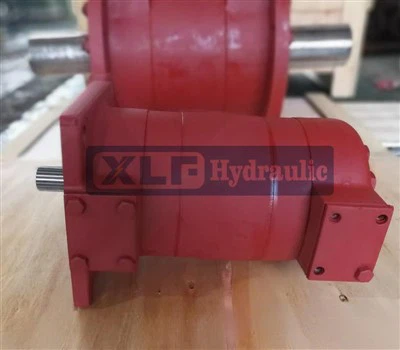
Let’s start with the basics, because there’s no getting around the parts that make an axial piston motor tick. A standard in-line axial piston motor has a block of pistons arranged in a circular pattern inside a housing, connected to a driveshaft. When high-pressure hydraulic fluid enters the motor, it pushes the pistons outward against a stationary swash plate, which angles the pistons slightly as they move. That angled motion translates the linear push of the pistons into the rotary motion needed to turn equipment, whether it’s a conveyor belt or a crane’s boom. Now, mechanical efficiency is the percentage of input power that comes out as usable rotary power—meaning every bit of power lost to friction, leakage, or internal pressure drops that number. Unlike electrical motors, which often hold a fairly steady efficiency range across their operational band, axial piston motors’ efficiency dances with speed, driven by three key friction sources and one leakage factor, all of which shift depending on how fast the motor is turning.
First, let’s break down the low-speed range. When a motor runs at very low RPM—think 100 RPM or less, common in applications like heavy augers or precision positioning of industrial presses—mechanical efficiency is often the lowest on the entire curve. Why? Friction is the main culprit here. The swash plate, piston shoes, and cylinder block all slide or rotate against stationary parts of the motor, and at low speeds, the thin fluid film that’s supposed to separate these metal surfaces is barely moving. Hydrodynamic lubrication, the process where fluid motion creates a wedge that lifts surfaces apart, is all but non-existent at low speeds. Instead, parts operate under boundary lubrication, where metal parts rub directly against each other, creating more friction and wasting power. I learned this the hard way early in my career: we supplied a small axial piston motor to a packaging company that used it to drive a high-speed label applicator, but their initial model ran at 80 RPM during operation and kept burning out seals faster than we could replace them. Testing showed their motor’s low-speed efficiency was only 62%, meaning 38% of the hydraulic power they pumped in was lost to friction and heat. Once we adjusted their system to run the motor at 300 RPM—still well within their application’s needs—efficiency jumped to 85%, and seal failures dropped by 90%.
That said, low-speed efficiency isn’t all doom and gloom. Some axial piston motors are designed with built-in features to boost low-speed performance, like cross-over holes in the piston shoes or micro-texturing on the swash plate to help build that fluid film faster. I always recommend these features for customers running heavy, low-torque loads, because while efficiency is lower than mid-range, it can be improved significantly without sacrificing power. The key here is that at low speeds, torque demand is usually very high—so while you might lose a bit to friction, matching the motor’s displacement to the load ensures you’re not forcing it to work harder than necessary.
Now, the sweet spot: mid-range speed, typically between 1,000 and 1,800 RPM for most standard axial piston motors. This is where mechanical efficiency peaks, often hitting 90% to 95% for well-tuned motors. Why? The fluid film that reduces friction is fully established here. The pistons, swash plate, and cylinder block are moving fast enough that the hydraulic fluid between them creates a thick, consistent layer that separates metal surfaces, cutting friction losses by a huge margin. Leakage also plays a role here: internal leakage happens when high-pressure fluid slips past the tight gaps between moving parts, like the piston and cylinder bore. At mid-range speeds, the piston’s reciprocating motion is fast enough that fluid doesn’t have time to seep through these gaps as easily as it does at low speeds, so less power is lost to leaks.
I see this play out every day with our agricultural customers, who use axial piston motors to drive combine harvesters’ reel systems and grain conveyors. Most of our standard motors are rated to run at 1,500 RPM under load, and their operators consistently report that when they run their equipment at that mid-range speed, the fuel usage drops by 15% compared to running at low RPM to save power, because the motor is converting almost all the hydraulic power into usable torque for the augers. Another example: a mine customer we work with uses axial piston motors to control their shuttle cars, which transport ore between processing stations. Their maintenance team logs that motors run at 1,600 RPM for the majority of shifts, and the annual repair cost for motor components is 40% lower than for older motors they used that only hit 78% efficiency at their peak speed. That’s the power of hitting the mid-range sweet spot—when the motor is designed to operate in that RPM band, efficiency stays high, and downtime drops.
But what about high-speed operation? When a motor runs above its rated maximum speed, typically over 2,000 RPM for most axial piston motors, mechanical efficiency starts to drop, and fast. The reasons here are a mix of friction and dynamic stress that wasn’t accounted for in the motor’s design. At high speeds, centrifugal force throws the pistons outward hard against the swash plate, increasing the contact pressure between the piston shoe and swash plate. That extra pressure squeezes the fluid film thinner, raising friction losses sharply. Additionally, the piston’s reciprocating motion becomes too fast to fully compress and decompress the hydraulic fluid in the cylinder bores, leading to cavitation—a phenomenon where low-pressure pockets form in the fluid, creating tiny bubbles that collapse and damage internal parts. Cavitation doesn’t just wear out motors; it also creates pressure spikes that waste power, bringing efficiency down.
I once had a customer in the material handling space who tried to over-speed our medium-duty axial piston motor to 2,500 RPM to make their conveyor system run faster. Within three months, the motor’s output torque had dropped by 22%, and the efficiency had fallen from 92% at mid-range to 74%. When we tested the motor, the piston shoes showed signs of excessive wear from the higher centrifugal force, and there was minor cavitation damage to the cylinder block. Once they slowed the system back to the motor’s rated 1,800 RPM, torque returned to its original level, and efficiency rebounded to 91%. This is a common mistake I see new customers make: assuming a motor’s power is unlimited, but axial piston motors are engineered for a specific speed range, and pushing beyond that range costs both efficiency and component life.
It’s also important to note that the relationship between speed and efficiency isn’t linear. That’s a point I emphasize to every new customer, because it’s where a lot of system design goes wrong. If you plot efficiency on a graph against speed, it’s not a straight line—it’s a curve that starts low at low speed, climbs steeply into the mid-range peak, then drops gradually as speed exceeds the motor’s rated limit. The steepness of that curve depends on the motor’s design: high-displacement motors (which move more fluid per RPM) often have a narrower, higher peak efficiency range, while low-displacement motors have a broader range that stays efficient over a wider set of speeds. For example, a high-displacement motor for a heavy lift crane will have a peak efficiency at 1,200 RPM, and efficiency drops off sharply if you run it at 500 RPM or 2,000 RPM, while a low-displacement motor for a small pump will stay around 88% efficiency from 800 to 2,000 RPM.
Another factor that often gets overlooked is pressure. Wait, how does pressure tie into speed? Well, hydraulic motors generate torque based on pressure, and the interaction between speed and pressure shapes the efficiency curve too. A motor operating at low speed under high load (high pressure) will have different efficiency than the same motor running at low speed under low load. I worked with a construction company last year that was using axial piston motors to power a skid-steer loader’s hydraulic attachment. They were running at low speed when lifting heavy concrete blocks (high pressure), and while the speed was low, the high pressure created a thicker fluid film between the pistons and swash plate, boosting their efficiency to 78%—higher than we’d expect for a motor at that speed. Adjusting pressure for the load, not just speed, is a small tweak that makes a big difference in overall efficiency, and it’s a tip we share with every customer who comes to us with performance issues.
So, what does this mean for someone relying on axial piston motors? It’s simple: matching the motor’s speed range to your application is the single best way to maximize mechanical efficiency. You don’t have to run a motor at its top speed to get the most out of it, and low-speed operation doesn’t have to mean poor performance if you choose the right motor design for the job. Over the years, we’ve adjusted our motor line to meet different needs, adding low-speed optimized motors for precision applications and broad-range motors for general use, and every time we help a customer align their speed and motor, they see a drop in energy costs and longer component life.

If you’re currently dealing with a motor that’s wasting power, breaking down too often, or not performing as expected, the solution almost always starts with looking at speed and how it interacts with your motor’s design. We’ve helped hundreds of customers across industries refine their hydraulic systems, and we can help you too—whether you’re troubleshooting an existing motor, designing a new system, or looking for a more efficient axial piston motor supplier. Reach out to our team to discuss your application, and we’ll walk you through the right motor and speed setup to boost your efficiency and reduce downtime.
Hydraulic Pump References:
- Manring, N. D. (2005). Hydraulic Control Systems. John Wiley & Sons.
- Ivantysyn, J., & Ivantysynova, M. (2003). Hydrostatic Pumps and Motors: Principles, Design, Performance, Modeling, Analysis, Control and Testing. Academic Books International.
- Merritt, H. E. (1967). Hydraulic Control Systems. John Wiley & Sons.
- Edge, K. A., & Darling, J. (1988). Pump and Motor Efficiency—A Review. Proceedings of the Institution of Mechanical Engineers, Part A: Journal of Power and Energy, 202(3), 185-196.
Wuhan Xinlaifu Hydraulic Equipment Co., Ltd.
Wuhan Xinlaifu Hydraulic Equipment Co., Ltd. is one of the most professional axial piston motor manufacturers and suppliers in China, featured by high quality OEM&ODM products. Please feel free to buy customized axial piston motor from our factory.
Address: Liansu Industrial Park, No.1, Xincheng 11th Road, Dongxihu District, Wuhan, Hubei, China
E-mail: service@xlf-hydraulic.com
WebSite: https://www.xlf-hydraulic.com/
