Let me tell you a story that’s played out in my workshop a dozen times this year alone. Last month, a small aerospace parts manufacturer called in a panic. They’d just burned out their vertical machining center’s drill chuck trying to produce a batch of turbine mounting brackets, and their backup drill press was down for repairs. “We thought slant bed lathes are just for turning,” the owner, Mark, said over the phone. “Can we even drill with ours?” That call is why I’m sitting here writing this—too many shops get stuck in that same narrow box about slant bed lathes, and I’m here to set the record straight. For 12 years, I’ve supplied slant bed lathes to shops across North America, and I can tell you this: the answer isn’t just “yes.” It’s “yes—and here’s why that’s a game-changer you’re wasting if you’re not using it.” Slant Bed Lathe

First, let’s get one thing clear: slant bed lathes were built for turning, but their design makes drilling not just possible, but better than what you get on a lot of standalone drill presses. Let’s break down the core design difference right away. A slant bed lathe’s bed is angled between 25 and 30 degrees toward the operator, compared to a flat-bed lathe that sits parallel to the floor. That angle does two critical things for drilling: it lets chips fall away from the cutting zone instead of piling up around the tool, and it brings the cutting tool (the drill, in this case) closer to the spindle centerline. Wait—let’s be specific here. When you mount a drill chuck in the live tool turret of a CNC slant bed lathe, you’re not just spinning a drill; you’re moving it with the same precision controls you use for turning. That means you can hold position tolerances of ±0.001 inches on a hole, something most manual drill presses can’t touch. I’ve seen Mark’s shop take a part that used to require two setups—one on the lathe to turn the bracket’s outer diameter, and another on a drill press to drill the four mounting holes—and cut cycle time by 40% by doing both on a single slant bed lathe. That’s the kind of win that makes shop owners lean in.
Now, let’s talk about the kind of drilling you can actually do on a slant bed lathe, because not all drilling is the same. A lot of people hear “drilling” and think only of straight through-holes or counterbores, but these machines handle way more. We supply our slant bed models with live tooling options that let you do center drilling, peck drilling, deep-hole drilling, even tapping and counter-sinking. Let’s take deep-hole drilling, for example. If you’re drilling a hole that’s four times the diameter (or deeper) of the drill bit, peck drilling is non-negotiable to clear chips and prevent the bit from snapping. On a standalone drill press, peck drilling requires manual stops that slow you way down. On a CNC slant bed lathe, you just input the peck depth and retract distance into the control, and the machine does it automatically, at 1,000 RPM or higher, without you touching a thing. Last quarter, we sold a slant bed lathe to a job shop that made hydraulic valve components. They were drilling 6-inch-deep holes in 2-inch-diameter steel bars; on their old flat-bed lathe, that took 12 minutes per hole. On our slant bed model, it took 4. That’s not a small gain—that’s doubling their production capacity for that part line overnight.
But here’s where I see most customers make the mistake: they treat drilling on a slant bed lathe like an afterthought, not a core function. Let’s talk about what makes this work reliably, because it’s not just slapping a drill in a turret and hitting start. First, tool holding is non-negotiable. A lot of cheap slant bed lathes come with collet chucks for turning, but if you’re drilling, you need heavy-duty hydraulic or ER collet chucks that grip the drill bit 360 degrees. If your chuck slips mid-drill, you’ll get a misaligned hole, a broken bit, or worse—damage to the $500 billet steel you’re using. That’s why we include heavy-duty tool holding as a standard add-on for our live tool-ready slant bed models; we learned early on that cutting corners here costs way more in downtime than the small upcharge.
Then there’s rigidity. Slant bed lathes are built with a one-piece cast iron frame, which is way stiffer than the welded steel frames of most drill presses. That rigidity eliminates vibration, which is key for clean hole walls and consistent tool life. I had a customer last year who tried drilling 1/8-inch holes in titanium on a cheap imported slant bed lathe he bought used. The hole walls were rough, and he snapped three bits in an hour. We upgraded him to our mid-tier slant bed model with premium linear guideways and balanced tool holders, and he cut drill breakage by 90% within a week. The difference was the rigidity—not just the brand, but the core design that the machine is built on.
Wait, but let’s address the elephant in the room: when is drilling on a slant bed lathe not the best call? No machine does everything, and I’d never steer a customer wrong. If you’re drilling 100+ identical holes in thin sheet metal, a drill press or turret punch might be faster. If you’re doing large-diameter drilling (over 2 inches) on very soft, low-tensile material, a dedicated drill press or radial arm drill will handle that better. But for 80% of the drilling work that small to medium job shops, aerospace suppliers, and automotive parts makers do—holes between 1/8 and 1.5 inches, in steel, aluminum, or even tough alloys like Inconel—a slant bed lathe is not just equivalent, it’s superior. It eliminates setups, reduces human error, and cuts lead times. That’s why a customer who used to send 20% of their work out to a drill shop now does it all in-house on their slant bed lathe.
Let’s get practical for a second, because I know you’re wondering about the numbers. Let’s take a common part: a 4-inch-long aluminum pulley with a 2-inch outer diameter, three 3/8-inch mounting holes, and a central bore that needs to hold a tight tolerance. On a traditional setup: turn the OD and bore on a flat-bed lathe (10 minutes), remove the part, move it to a drill press, clamp it three separate times (8 minutes), drill and tap the holes (12 minutes), deburr (3 minutes). Total time: 33 minutes, with two extra clamp steps that leave room for human error and tolerance drift. On our slant bed lathe: mount the part once, turn the OD and bore (10 minutes), move the live turret to the drill chuck, drill and tap the three holes (7 minutes), deburr with a side tool (1 minute). Total time: 18 minutes, with zero extra clamp steps. That’s almost half the time, and the holes are aligned perfectly with the bore because they’re all set in the same machine coordinate system. I’ve run these numbers on hundreds of parts, and the average customer sees a 30-45% reduction in total lead time for parts that require both turning and drilling.
Another thing people don’t talk about: operator skill. Let’s be real—good machinists are hard to find these days. A slant bed lathe that does both turning and drilling lets you use one operator for a job that would have required two separate skilled workers. Instead of training a machinist on both lathe work and drill press setup, you train them on one machine’s control, and they can handle every step of the part production. That’s a huge win for small shops that can’t afford to staff multiple specialized roles. I had a customer in Detroit who told me he used to need three people running his shop at once; now he runs two slant bed lathes with one part-time helper. The savings on labor paid for the machines in 18 months.
Now, let’s talk about common myths I still hear, even after 12 years in this business. Myth 1: “Drilling on a slant bed lathe is less accurate than a drill press.” No—when you’re working within the 1/8 to 1.5 inch range, our slant bed lathes hold positional tolerance better than most manual drill presses, and almost as well as CNC drill presses. The only time you see accuracy drop is if you’re using a cheap tooling setup, not the machine itself. Myth 2: “You can’t do deep-hole drilling on a slant bed lathe.” I mentioned that hydraulic valve job earlier—they were drilling 6-inch deep holes, which is 30 times the drill diameter, on a slant bed lathe. The key is using a long, rigid drill bit and the machine’s peck cycle, which we program into the control for every customer when we deliver their machine. Myth 3: “It’s too expensive to convert a slant bed lathe to do drilling.” If you buy our slant bed models pre-configured with live tooling, the upgrade to add a drill chuck and tool holders is less than $2,000. That’s a tiny investment compared to buying a standalone drill press, which costs $10,000+ for a reliable CNC model.
Wait, let’s circle back to Mark, the aerospace shop owner I mentioned at the start. He called me last week to update me. They used that slant bed lathe to drill the four mounting holes on their turbine brackets, and they just landed a $200,000 contract for 500 of the parts. “I would have lost that bid,” he said, “if I’d had to quote two setups. You guys didn’t just sell me a lathe—you sold me the ability to take on jobs I couldn’t before.” That’s the impact this technology has. A lot of shops see slant bed lathes as a turning tool, but when you add live tooling, drilling, tapping, even milling, it becomes a full-production cell that fits in the footprint of one machine. No more moving parts between tools, no more wasted time re-clamping, no more mistakes from handoff between operators.
Now, if you’re reading this and thinking, “Hey, I have a slant bed lathe sitting in my shop that I’ve never used for drilling,” let me leave you with a few quick tips to get started. First, check if your machine has live tooling capabilities—if not, it’s a simpler upgrade than you think. Second, invest in quality tooling: ER32 collets for small drills, hydraulic chucks for larger ones, and make sure your tool lengths are calibrated so the drill hits exactly where you want it. Third, start small: practice drilling a few holes in scrap material before you touch your production parts, so you get comfortable with the control’s peck cycles and feed rates. And if you’re not sure where to start, we offer free setup consultations for every customer we sell, to help them configure their machine for both turning and drilling, and train their operators on the basics.
At the end of the day, machinery is supposed to work for you, not the other way around. For too long, manufacturers have siloed lathes, drill presses, and mills into separate boxes, forcing shops to buy more equipment than they need and hire more skilled labor than they can afford. A slant bed lathe that does drilling changes that. It’s a versatile, space-saving, cost-effective solution that lets you take on more jobs, work faster, and keep more production in-house.
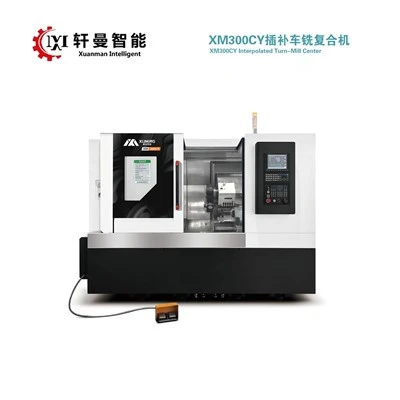
If you’re ready to stop underutilizing your lathe and start doing more of your drilling in one setup, we can help. We’ve supplied slant bed lathes to shops from coast to coast, and our team has the experience to help you configure a machine that fits your specific production needs. Don’t let another opportunity slip away because you thought drilling was only for drill presses. Reach out today to talk through your part requirements, cycle times, and production goals—we’ll help you build a solution that works for your shop, not against it.
Flat Bed CNC Lathe References:
- Smid, P. (2008). CNC Programming Handbook. Industrial Press Inc.
- Oberg, E., Jones, F.D., Horton, H.L., & Ryffel, H.H. (2016). Machinery’s Handbook (31st ed.). Industrial Press Inc.
- Slant Bed Lathe Design & Performance Guidelines. (2021). Machine Tool Technology Association.
Jiangsu Xuanman Intelligent Equipment Co., Ltd.
As one of the most professional slant bed lathe manufacturers in China, we’re featured by quality products and low price. Please rest assured to buy discount slant bed lathe made in China here from our factory. Customized orders are welcome.
Address: No.1-1, Weier Road, Jieji Equipment Manufacturing Industrial Park, Sihong County, Suqian City, Jiangsu Province, China
E-mail: jsxmzn@163.com
WebSite: https://www.xm-machs.com/
